
Madison County Criminal Court Cases
Madison Circuit Court hears felony prosecutions. Madison District Court hears misdemeanors, traffic cases, and violations, and it conducts preliminary felony proceedings before indictment. The same elected Circuit Court Clerk maintains both sets of Madison County criminal court cases, but the files sit at different counters. Circuit files are at the Madison County Courthouse, 101 W. Main Street in Richmond. District files are at the Hall of Justice, 351 W. Main Street. The Kentucky Court of Justice Madison County directory lists each division and its contact line.
A felony can therefore appear first in a Madison County District Court file and later in Circuit Court after a grand jury indictment. That is not a duplicate trial. District Court handles the early judicial steps, while Circuit Court holds the felony trial-level record. Family Court is at 119 N. First Street and handles family matters and some protective proceedings, not the ordinary criminal docket. All three local court locations publish weekday hours of 8 a.m. to 4 p.m., excluding closures.
Madison County Clerk File Search
The clerk is the most direct source for a specific Madison County court file. Call Circuit at 859-624-4713 for felony records or District at 859-624-4722 for misdemeanors, traffic matters, violations, and preliminary felony proceedings. Give a case number when known. With only a name, add the full legal name and an approximate filing year, then ask whether the clerk needs another identifier to avoid a false match.
Request the docket sheet and final disposition first. The docket lays out events in date order, and the disposition shows what happened to each filed charge. Those two items often answer the main question before a reader pays for a large copy set. Next, ask for the complaint or citation, indictment, plea, judgment, sentence, motions, or other named papers that matter. The clerk can quote the current copy and certification price rather than leaving the requester to guess.
The official Madison courts page provides a view of the local courthouse and office contacts.
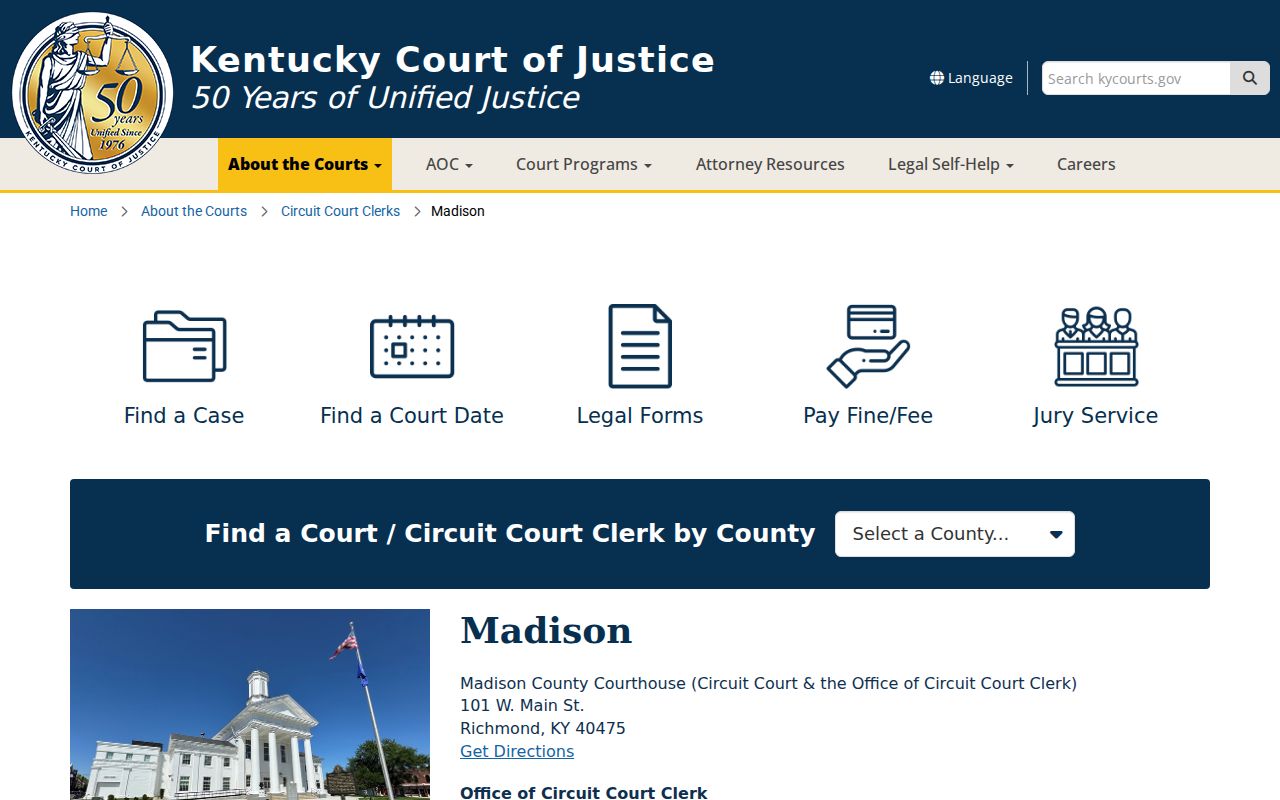
The pictured court directory reinforces why the court division matters before a call or records-counter visit.
Searching Madison County Case Records
Use the local file when the goal is to understand one prosecution or obtain a certified copy. Use an Administrative Office of the Courts report when the goal is a Kentucky court-record report. CourtNet covers public case information from all 120 counties, but it is not an unrestricted free public name-search site. AOC FastCheck requires an account, while the one-time request channel serves occasional orders. Neither channel turns an electronic report into the clerk's full Madison County case file.
- Identify whether Madison District or Circuit Court handled the case, then call the correct clerk line.
- Supply the case number, or provide the full legal name and approximate year when the number is unknown.
- Ask for the docket sheet and final disposition before selecting extra documents.
- Confirm whether the file is on site, archived, sealed, or affected by a retention schedule.
- Arrange inspection, ordinary copies, or certified copies and confirm the current price with the clerk.
The AOC background-check page shows the FastCheck and one-time report options.
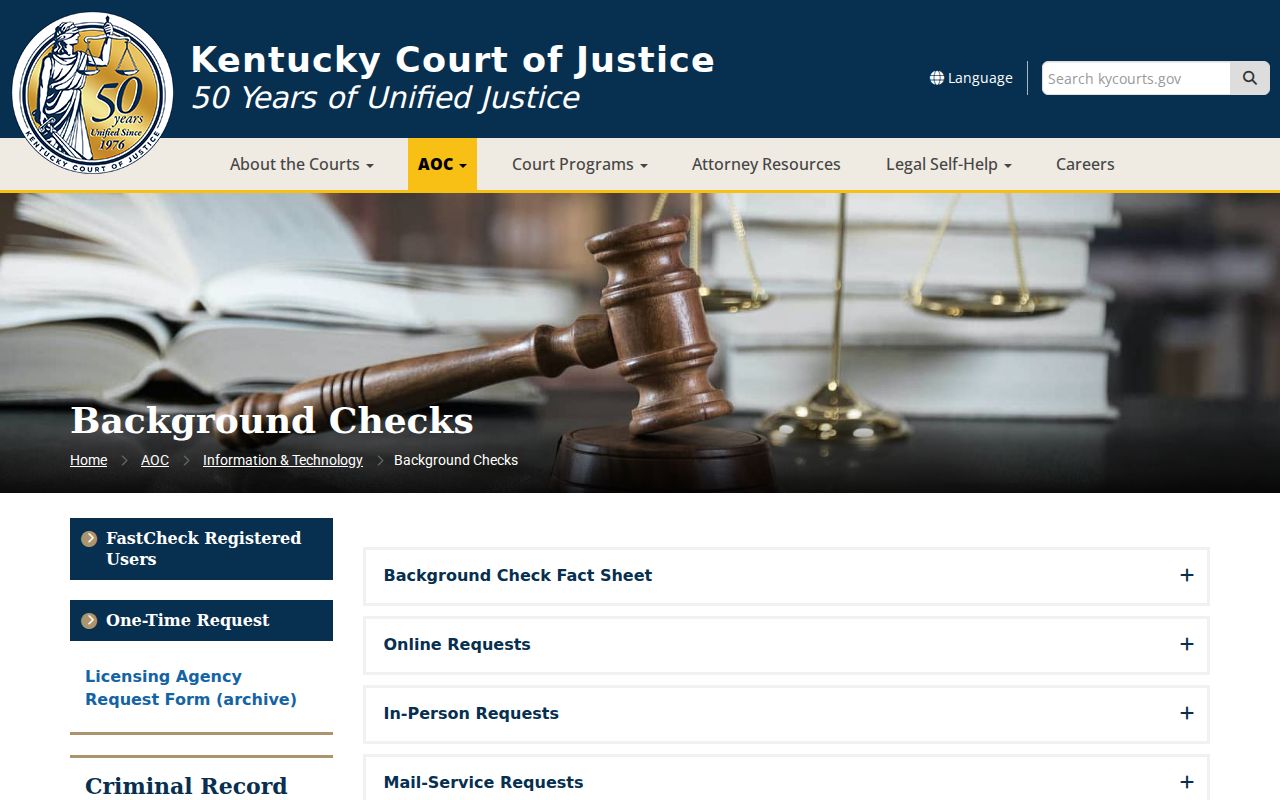
This state report channel works best when the requester enters exact identity data and chooses the current product with care.
| Field | Type | Required | Notes |
|---|---|---|---|
| Requester or account | Login/contact | By product | FastCheck account or one-time order details |
| First and last name | Text | Yes | Use the subject's legal name |
| Middle name | Text | Unspecified | Helps distinguish common names |
| Date of birth | Date | Yes | Exact data improves matching |
| Other identifiers | Protected/text | Product-dependent | Enter only through the official secure channel |
| Report and payment | Choice/card | Yes | Current fee appears during ordering |
Madison County CourtNet Record Limits
CourtNet is a statewide judicial database. It can support a Kentucky court-record report, but its existence does not grant the general public a free, unrestricted name search. The Madison County clerk remains the official custodian for pleadings, orders, local docket material, and certified copies. A state report may assemble reported case data, while a local file may contain the actual indictment, motion, judgment, or sentencing paper behind an entry.
Use the two sources for different jobs. An AOC report can give a broader Kentucky court view. A clerk-certified copy is the stronger choice when the exact Madison County disposition or document must be established. A common name needs close checking against date of birth and case details. A matching name alone is not proof that the record concerns the same person.
Inside a Madison County Case File
A Madison County criminal case file connects the charge the Commonwealth filed with the court events and final result. Not every docket entry has a downloadable image. The public index may show that a document exists while the clerk supplies the actual paper. Protected identifiers, victim details, juvenile material, and sealed records are not reproduced merely because other portions of the case are public.
| Case Number and Court | County, division, case type, filing sequence, judge, status, and filing date. |
|---|---|
| Charging Document | Complaint, citation, or indictment with counts, descriptions, KRS citations, and charge class. |
| Docket Entries | A dated list of hearings, motions, notices, pleas, warrants, orders, and later filings. |
| Hearing Details | Date, time, location, and event type when those fields are public. |
| Disposition and Judgment | The outcome of each charge, including dismissal, acquittal, plea, or verdict. |
| Sentence and Conditions | Sentence, probation, revocation events, public financial obligations, and appeal entries. |
Note: A booking charge can change before judgment, so compare each count with the final Madison County disposition.
Reading Madison County Docket Terms
A few plain terms make a docket easier to follow. The count is one separately stated charge. An indictment is the grand jury's formal felony accusation, while an arraignment is the hearing where the filed charges and plea are addressed. The disposition is the result of a charge or case. A capias or bench warrant is court process directing an arrest, often after a missed appearance or failure to follow an order.
- Docket
- The dated list of filings and court actions.
- Amended charge
- A filed charge changed from the earlier allegation or booking label.
- Nolle prosequi
- The prosecutor's formal decision not to proceed with a charge.
- Disposition
- The court-recorded outcome of a count or case.
- Judgment
- The court's formal ruling, including a judgment of guilt when applicable.
Read terms in sequence. A plea to an amended count can yield a conviction that differs from the arrest entry, and a dismissed charge should not be read as a finding of guilt. The Madison County criminal court case record is the place to trace those changes.
How a Criminal Case Moves
A criminal case does not always follow every possible stage. A citation may begin without jail booking. A dismissed allegation may never reach indictment. Felony matters can start in District Court, then move to Circuit Court after grand jury action. Motions, plea talks, or a trial occur only when the case reaches those points, and later probation or appeal filings may reopen docket activity after judgment.
Case flow: Complaint or citation › Initial appearance › District Court preliminary step › Grand jury indictment › Circuit Court arraignment › Pretrial motions › Plea or trial › Disposition › Sentencing
The court file follows prosecution, not just custody. For booking data that predates filing, use the county's Madison County arrest lookup channels and then return to the clerk for the outcome.
Archived Madison County Criminal Cases
An absent file is not always sealed or destroyed. Older Madison County criminal court cases may have moved to a state records facility. The clerk first checks availability and identifies the correct State Records Center. Ask the clerk for both the case number and file-locator number before contacting the archive. Those identifiers keep a records request tied to the right box and case.
The official Kentucky court-record request instructions explain the clerk-first fallback.
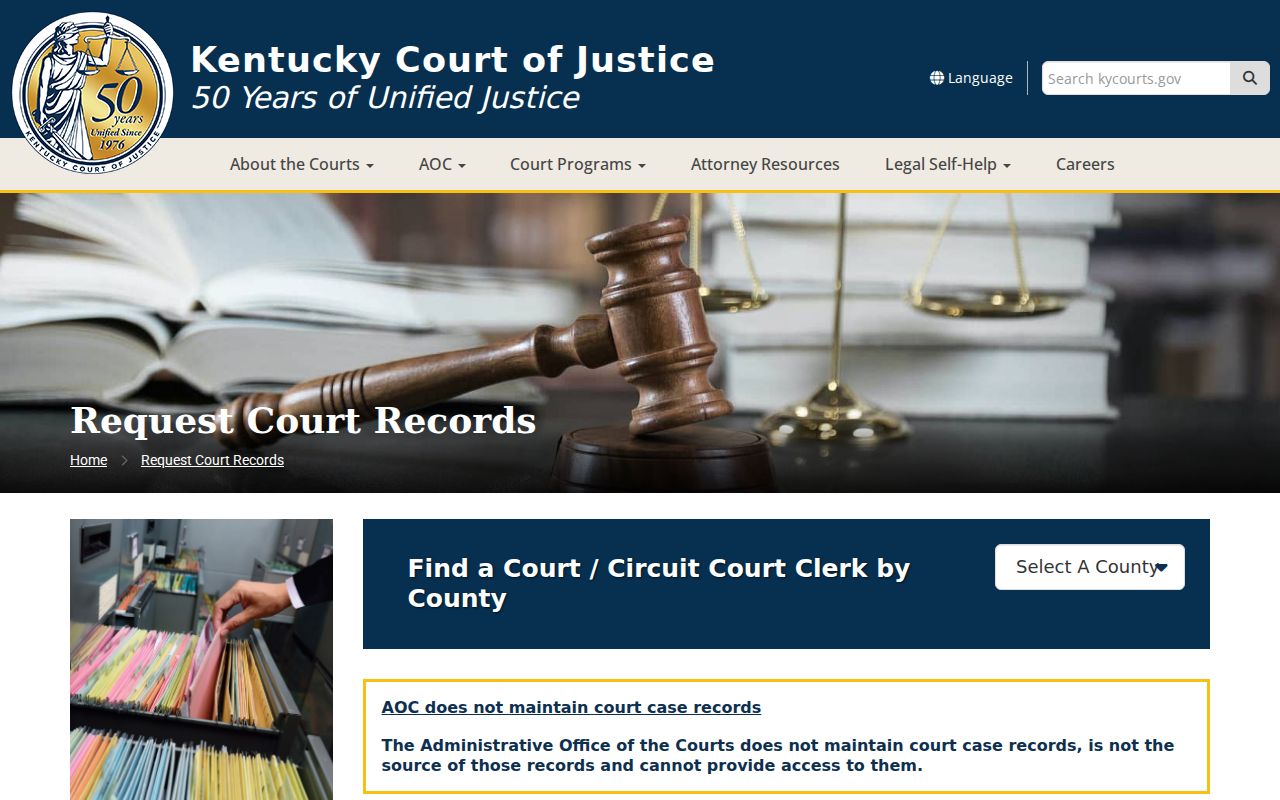
The archive path begins only after the Madison County clerk confirms that the file is no longer held locally and supplies its locator data.
Send the supplied identifiers to state.records@ky.gov or call 502-564-3617. AOC warns that it is not the custodian of trial-court files, so sending a vague document request to AOC can delay the search. Ask the trial clerk first, then use the state records route it provides.
Federal Cases Beyond Madison County
Madison County lies in the U.S. District Court for the Eastern District of Kentucky. A federal criminal file is separate from Madison District or Circuit Court. PACER requires an account and can show the federal indictment, docket events, detention orders, plea, judgment, and sentence. The federal judiciary sets usage fees and describes its quarterly waiver threshold on the current pricing page.
The official PACER service provides federal docket and document access.
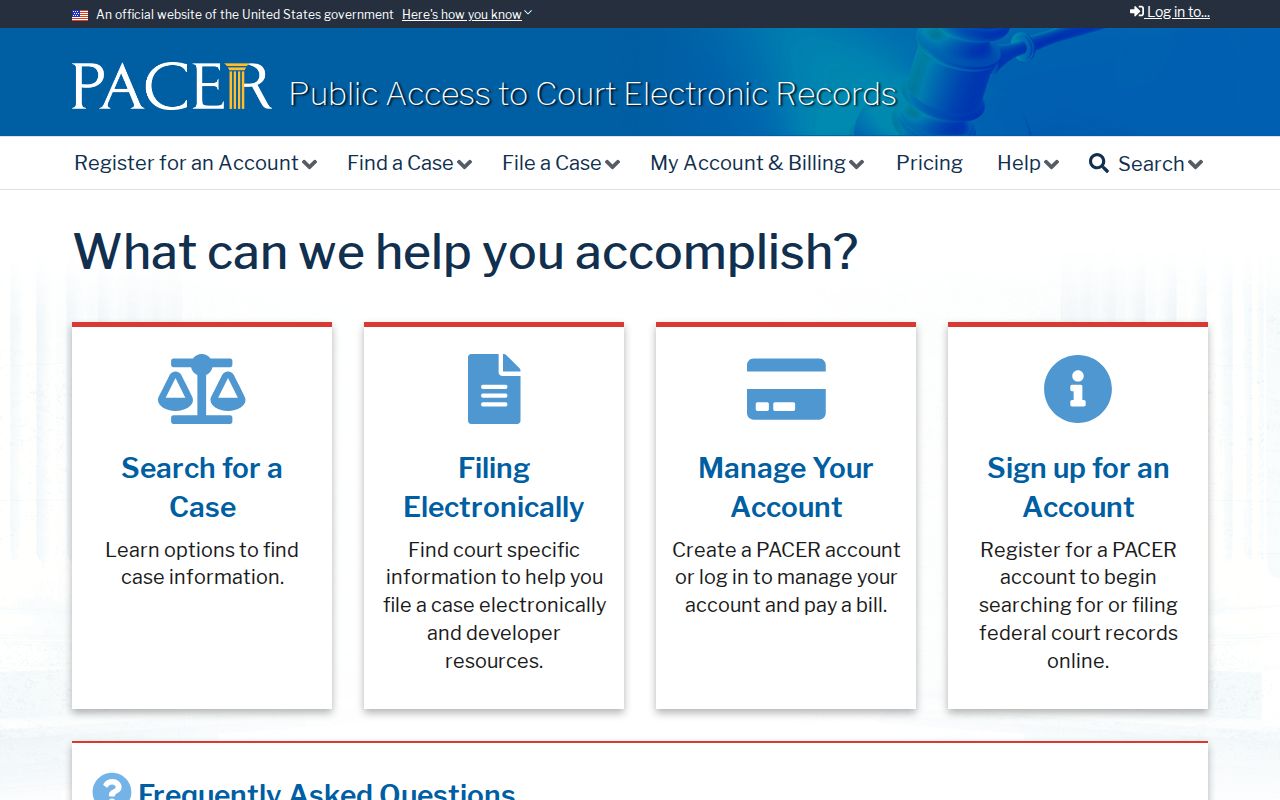
This image marks the boundary between a federal search and the local Kentucky case files kept by the Madison County clerk.
Case Record Access & Restrictions
Kentucky trial-court requests start with the clerk that heard the case. The Kentucky Open Records Act governs agency records, but the Kentucky Court of Justice applies its own court-record access rules under KRS 27A.099. Court files can omit or protect Social Security numbers, victim or minor information, juvenile matters, sealed records, and other confidential data. A public docket also may lack a document image that the clerk can inspect or copy.
When a Madison County case does not appear, ask whether the problem is an archived file, a spelling or year mismatch, sealing, expungement, destruction under retention rules, or access limits. Redaction removes protected details while releasing the nonexempt rest. Sealing or expungement changes access under a court order. Do not infer that a missing online result proves that no case ever existed.
Access point: Ask the Madison County clerk for the docket, disposition, file status, and current copy terms before using a state report or archive fallback.